FCF's Commitment to the 2030 Agenda
The FCF maintains its commitment to ethics, responsibility and sustainability as fundamental pillars of its institutional management, aligned with the Sustainable Development Goals.
THE 2030 AGENDA AND THE SUSTAINABLE DEVELOPMENT GOALS
The Catalan Football Federation maintains its commitment to ethics, responsibility and sustainability as fundamental pillars of its institutional management. In this framework, the entity was part of the United Nations Global Compact, sharing the values linked to the Sustainable Development Goals (SDGs) and the 2030 Agenda.
During this period, the Federation also joined the Catalunya 2030 Alliance, a joint initiative promoted by various Catalan organizations and entities with the aim of promoting collaborative actions, sharing resources and fostering projects aligned with sustainable development.
In recent years, the Catalan Football Federation has promoted different initiatives aimed at reinforcing its economic and social sustainability, as well as transparency and good governance measures, including criminal compliance policies. Currently, the entity continues working to consolidate a management model balanced between economic, social and environmental dimensions.
To materialize this commitment, the Catalan Football Federation approved an action plan oriented towards the implementation of the Sustainable Development Goals (SDGs). This process included:
- The definition of the structure and functions of the participation bodies.
- The identification, classification and quantification of the main stakeholder groups linked to federative activity.
- The establishment of the eight strategic SDGs on which the entity would focus its contribution.
- The promotion of a practical guide to advance in sustainability within the sports sector.
- The application of international methodologies and standards adapted to the organization's reality.
- The definition of the key elements for the project implementation, such as participation, resources, alliances and communication.
- The identification of possible challenges and expected benefits derived from the integration of sustainability criteria in federative activity.
STRUCTURE AND FUNCTIONS OF PARTICIPATION BODIES
To materialize the commitment to the SDGs and the 2030 Agenda, the FCF has established five participation bodies:
1. ADVISORY COMMISSION
It is a body created to advise the Board of Directors and the working group on sustainability matters. The advisory commission is made up of external professionals with knowledge and experience in sustainable development.
2. THE SDG DEFENDERS
They are 8 people (1 per SDG), who are tasked with promoting the Sustainable Development Goals and making public interventions on the different SDGs of the Federation.
3. THE WORKING GROUP
It is the creating team and working instrument of the 2030 Agenda implementation project at the Federation by delegation of the Board of Directors. The working group is composed of a coordinator, a secretary and 5 additional members.
4. THE SUSTAINABILITY COMMISSION
It is the active coordination between the Board of Directors and the commissions and committees of the Federation with the main functions of transferring and implementing the contents of the 2030 Agenda, promoting and organizing the participation of stakeholder groups, etc. The Sustainability Commission is formed by: a member of the Board of Directors, a secretary and a club representative, a male and female member, a coach, a referee, an FCF employee, a delegation representative and a fan.
5. THE SDG PROMOTERS
They are the drivers of the SDGs on the ground by disciplines, committees, delegations and functional areas of the FCF. Their main functions will be the processes of awareness, training, participation and collection of actions in their areas of collaboration.
STAKEHOLDER GROUPS
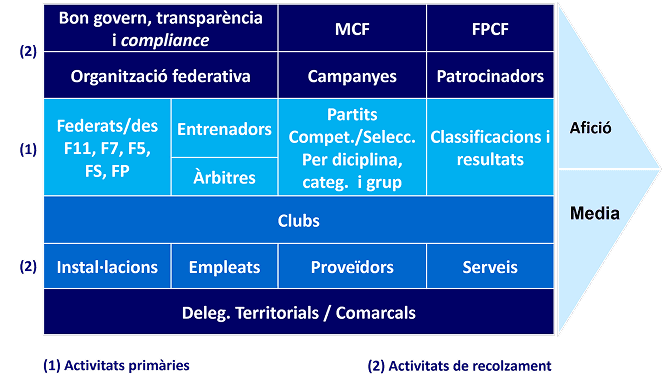
The federative body recognizes 11 categories of stakeholder groups, which are all those linked to the development of the usual activities of the Catalan Football Federation. In short, they are the actors of the sustainable development goals that, approximately, approach one million people.
STAKEHOLDER CATEGORIESSUB-GROUPS OF INTEREST
- 1. The Assembly of Clubs: Clubs, sports associations, private entities and representatives of the value chain and sports disciplines
- 2. The Board of Directors: Its members and bodies
- 3. The Value Chain: Clubs, members, referees and coaches
- 4. The employees: Central, territorial and regional
- 5. The linked entities: MFC and FPCF
- 6. Sponsors/suppliers/financial institutions: Sponsors/suppliers/financial institutions
- 7. The fans: Members and fans in general
- 8. The sector: RFEF, UFEC, UEFA and FIFA
- 9. The media: Print, audiovisual, social networks and others
- 10. Public administrations and regulators: SGEiAF and others
- 11. Environment: Civil society and environment
While in the following image, the quantification of the relevant stakeholder groups is contemplated:






THE 8 SDGs TO CONTRIBUTE TO
Through the Federation's own activities, it will contribute both directly and indirectly to the achievement of the following SDGs
- MILESTONES ASSOCIATED WITH THE 8 SDGs. HEALTH AND WELL-BEING
Promote the well-being of members, and promote a healthy lifestyle through the practice of football, in addition to adopting and establishing hygiene and safety standards for new needs. - QUALITY EDUCATION
Guarantee quality education for stakeholder groups, such as providing clubs with training and education for the use of technologies or promoting values where members enjoy the best experience. - GENDER EQUALITY
Achieve gender equality. Accelerate accessibility to women's football, ensure an equal and plural image in the media or, for example, implement regulations on equality plans. - DECENT WORK AND ECONOMIC GROWTH
Consolidate sustained economic growth. Invest in the development of clubs and promote new forms of work in accordance with new realities. - INDUSTRY, INNOVATION AND INFRASTRUCTURE
Promote sustainable mobility for the value chain's travel, foster innovation, adapt web information to new realities, as well as develop information technologies. - RESPONSIBLE CONSUMPTION AND PRODUCTION
Promote the adaptation of sports facilities of clubs, raise awareness among stakeholder groups about respect for the environment and climate change, manage waste in sports fields and facilities and, for example, promote efficient use of water for irrigation of grass. - PEACE, JUSTICE AND STRONG INSTITUTIONS
Promote football as a diverse, fair, peaceful and inclusive sport among stakeholder groups. - PARTNERSHIPS FOR THE GOALS
Build alliances to achieve the objectives with organizations, companies and sponsoring institutions that contribute to the sustainable development of the Federation and the achievement of the goals.
You = player, coach, referee, employee, executive and fan
For Sustainable Development and the SDGs and the 2030 Agenda. First, let's start by defining these terms: • We understand Sustainable Development as that which meets the needs of the present generations without compromising the ability of future generations to meet their own needs. • The 17 Sustainable Development Goals (SDGs), developed by the United Nations (UN) aim to address the major global challenges regarding people, planet, prosperity, peace and partnerships. They are 17 general goals, 169 targets and 232 general indicators that governments, institutions, associations and civil societies must adopt in their environment. • The 2030 Agenda is the deadline to achieve them, as well as a series of guides, methodologies and tools that the UN and related organizations make available for their implementation.
Secondly, the FCF wants to contribute to the development of the 2030 Agenda for Catalan football, establishing 8 SDGs, 50 targets and more than 50 indicators that the Federation established in the Declaration made in September 2020. We still have a lot of work ahead, such as translating the SDGs and targets into concrete economic, social and environmental actions and their subsequent implementation.
However, we players, coaches, referees, employees, executives and fans are also called to implement the 2030 Agenda on a personal level and to participate in the implementation of the Clubs.
Knowing and fulfilling the SDGs is a responsibility of everyone, but how? 1. Becoming aware of the economic, social and environmental problems for Sustainable Development. 2. Sensitizing and training ourselves in the basic concepts of the SDGs and the 2030 Agenda. 3. Mobilizing through the implementation of measures at a personal level and participating in the implementation of Clubs. 4. Spreading the messages and practices carried out in our environments.
We make it easy for you. Below we propose you follow a practical guide (which we will update periodically) where you can easily put into practice the process of personal and Club implementation of the 2030 Agenda. This guide we present should lead you to live more sustainably in your daily life and at work, changing your consumption patterns, means of transport, etc. Everyone is invited to participate and accept the challenge. In short, make change possible.
1. raise awareness
Of environmental, social and economic problems
- Pollution of the living world
- What is sustainability?
- Yes to fighting climate change
- Environmental awareness
2. sensitize
Acquire skills in sustainable development and the 2030 Agenda
- Sustainable development goals
- FCF training platform
- Go Goals! game
- Frieda game
3. PUT INTO PRACTICE
Self-assessment test and generate attitudes to solve problems
- 170 daily actions to transform our world
- Guide to 'Strikes to save the world'
- Act Now
4. PARTICIPATE WITH THE CLUB
Developing your sense of responsibility
- Check the Club website for 2030 Agenda progress
- SDG/target prioritization
- Proposals/development of actions
- Become a promoter
- Goods recognitions
5. DISSEMINATE/SPREAD
Expanding the SDGs in your family, academic, work, sports environment...
- Digitally the image of the 2030 Agenda and news
- Ecological e-merchandising products
- Good practices
To contribute to sustainable development, SDGs and the 2030 Agenda of your sports environment
In Catalonia we have a great potential for impact for the development of the 2030 Agenda: around 1,300 clubs, 180 thousand members and 1 million fans. The United Nations considers sport as "a facilitator of sustainable development promoting peace, respect and tolerance, also supports the empowerment of women and youth, people and communities, as well as the objectives regarding education and social inclusion". You must ensure that your players, coaches, employees and Board of Directors, your sports facilities and fans are in line with the achievement of the SDGs by 2030, participating in the local Club implementation process.
Alliances are considered by the UN as a necessary cooperation element that strengthens the means of implementation of actions associated with the SDGs and achieves development goals. We propose that alliances be, from the start of projects, on equal footing between the parties and that they bring transformative impacts.
We wish to collaborate with the FCF's 2030 Agenda by mobilizing and exchanging knowledge, capacities, techniques, technology and/or financial resources with us.
- A look at the FCF
- Effective alliances
- What the FCF brings to alliances
- Profiles of the best allies
- Find your interest
- Analyze collaborative approaches
- Alliance map
- Projects we want to share
- The association protocol